Software Development for Startups
Early-stage companies need to learn fast without building a product they will have to throw away. We help founders and product leaders define the right first release, build it on foundations that scale, and grow the engineering team as traction arrives.

Industry challenges
Common startup engineering traps
Startups rarely fail because they cannot write code. They struggle when time, money and focus are spent on the wrong things at the wrong stage.
Building too much before validating
Teams often spend months on features nobody has asked for. Without a tightly scoped first release and real user feedback, runway disappears before the product finds its market.
Technical debt that blocks growth
Shortcuts taken to hit a demo can become structural problems. Weak data models, missing tests and manual deployments slow every release once customers depend on the product.
Hiring engineers is slow and expensive
Recruiting senior engineers in US markets takes months and consumes founder time. Meanwhile, the roadmap stalls and competitors keep shipping.
Enterprise readiness arrives suddenly
The first large customer brings security questionnaires, single sign-on, audit logs and uptime expectations. Products not designed for these requests face a painful scramble at a critical moment.
AI expectations from customers and investors
Buyers and investors now ask how a product uses AI. Bolting on features without a clear use case adds cost and risk without improving retention or differentiation.
Digital transformation
How the right partner changes the trajectory
The best early-stage engineering is opinionated about scope and conservative about architecture. A short discovery phase that defines the riskiest assumptions, the smallest useful release and the metrics that prove value prevents months of wasted build. Choosing proven, well-supported technologies keeps the codebase approachable for future hires. Automated testing and deployment from day one cost little early and save a great deal later, when every release reaches paying customers and mistakes are far more visible.
As traction builds, the challenge shifts to scaling the team and the platform together. A dedicated team that already knows the codebase can absorb new features, integrations and enterprise requests without the delay of hiring from scratch. Our startup case studies show what focused engineering can achieve: Snapn reports 68% less documentation time and 99.9% uptime on its AI documentation platform, while VVanta reports 85% faster campaign launches after building an AI-driven campaign framework with Ability.
Solutions
What we build with startups and SaaS teams
Product discovery and MVP scoping
Workshops that turn a vision into a prioritized first release, with user journeys, clickable prototypes and a delivery plan tied to the assumptions you most need to test. You leave with a backlog your team or ours can start building immediately.
MVP and first-release engineering
A production-ready first version built on a maintainable architecture, with authentication, billing hooks, analytics and automated deployment included from the start. Analytics events are defined up front so you can measure activation from launch day.
Multi-tenant SaaS platforms
Tenant isolation, role-based access, subscription management and admin tooling designed so the product can serve many customers securely as you move upmarket. Pricing tiers and feature flags are configurable without code changes.
AI features with a clear purpose
AI-assisted workflows, search, document processing and automation built around a specific user problem, with evaluation, cost monitoring and guardrails rather than demos. We measure whether each AI feature actually improves retention or saves users time.
Enterprise readiness
Single sign-on, audit logs, data export, uptime monitoring and security hardening that help you pass procurement reviews and close larger contracts. We also help prepare the technical answers for security questionnaires.
Product design and UX
Interface and experience design in Figma, from onboarding flows to complex dashboards, tested with real users so activation and retention improve with each release. A shared design system keeps the interface consistent as more engineers contribute.
Cloud infrastructure and DevOps
Infrastructure as code, CI/CD pipelines, observability and cost controls on AWS or Azure, so your platform scales predictably and your team can release with confidence. Staging and preview environments come standard.
Dedicated and extended teams
Engineers, designers and QA specialists who join your workflow and tools, scaling up for major releases and continuing to support the product as it grows. Team members stay with your product so knowledge accumulates rather than resets.
Technology
Technologies we apply
 Next.js
 React
 TypeScript
 Node.js
 Python
 FastAPI
 PostgreSQL
 AWS
 Docker
Proof
Startups & SaaS case studies
 AI
Snapn
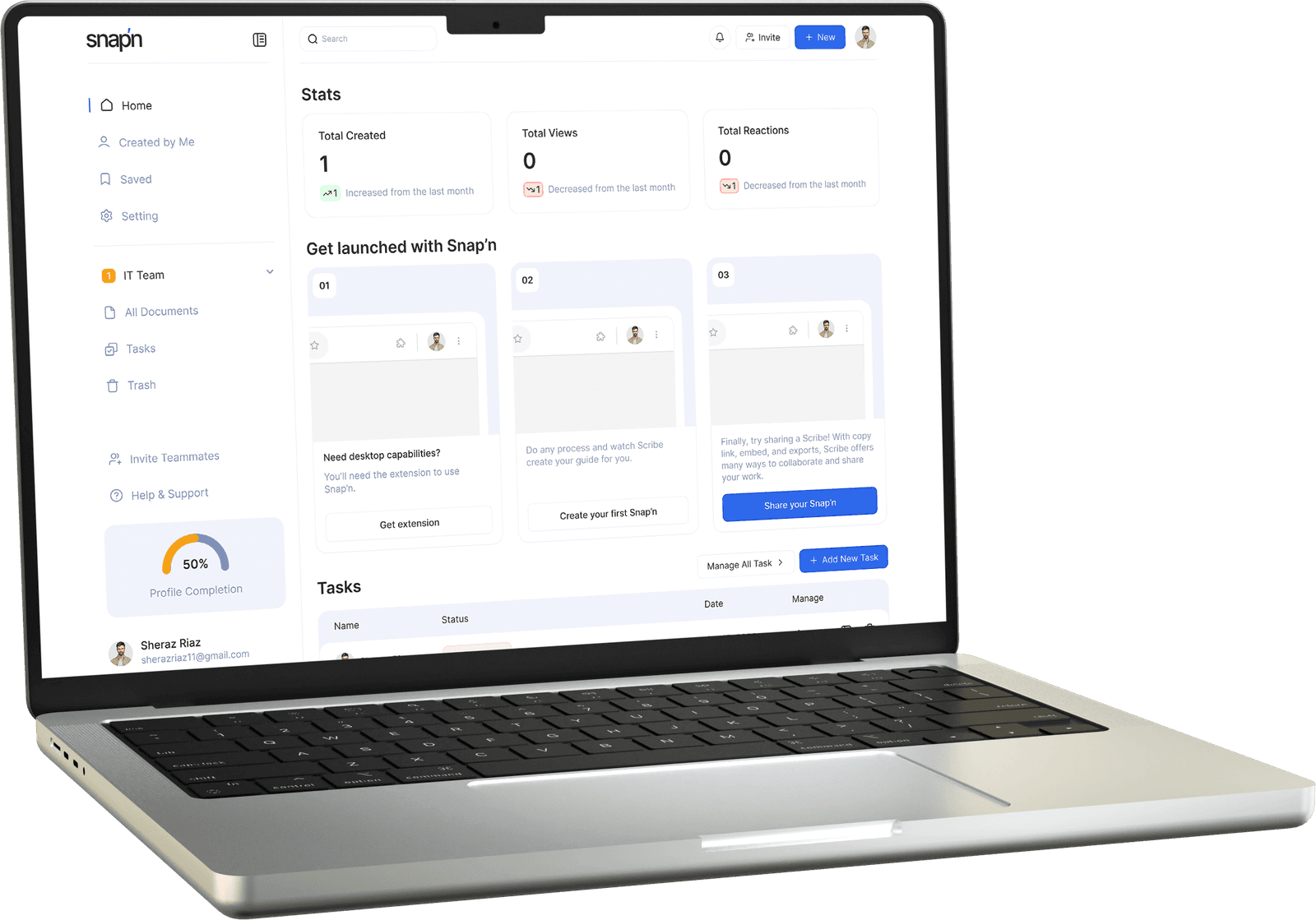
Snapn: Accelerating Documentation with AI Workflow Automation
Ability designed and engineered Snapn’s AI-powered documentation platform, helping teams create, manage and scale knowledge with far less manual effort.
- Documentation Time Reduced
- 68%
- Team Productivity Increase
- 2.7x
 Digital Marketing
VVanta
VVanta: AI-Powered Campaign Execution for Digital Marketing
Ability helped VVanta replace fragmented campaign workflows with a structured, AI-powered execution framework spanning Meta, Google Ads, TikTok and programmatic platforms.
- ROAS Improvement
- 50%
- Campaign Setup Efficiency
- 85%
Outcomes
Business outcomes we work toward
- 01
Faster path to customer feedback
Tight scoping and automated delivery get a usable product in front of customers sooner, so decisions are based on evidence instead of assumptions.
- 02
Productivity gains for users
Well-targeted automation changes how customers work. Snapn reports 68% less documentation time and 2.7x team efficiency on the platform Ability helped build.
- 03
Reliability customers can trust
Production-grade infrastructure and monitoring support growth without firefighting. Snapn reports 99.9% uptime and more than 120K documents processed.
- 04
Faster go-to-market execution
Structured workflows and AI-assisted operations speed up delivery. VVanta reports 85% faster campaign launches and a 50% ROAS improvement.
- 05
Engineering capacity without hiring delays
Dedicated teams let you add skills and capacity as the roadmap demands, while founders stay focused on customers and fundraising.
Services
Services for Startups & SaaS
SaaS Development
Multi-tenant SaaS products engineered for onboarding, billing, security and growth, from MVP to scale.
Explore serviceUI/UX Design
Research-led product design, prototypes and design systems that make complex software clear, usable and ready to build.
Explore serviceAI Development
AI consulting, LLM and generative AI applications, NLP and AI integration engineered into the products and systems you already run.
Explore serviceDevOps Services
CI/CD pipelines, infrastructure as code, observability and automation that make releases frequent, safe and routine.
Explore serviceDedicated Development Teams
A long-term engineering team that works only on your product, built around your stack, roadmap and working hours.
Explore serviceIT Staff Augmentation
Vetted engineers who join your existing team, follow your processes and scale up or down as project demand changes.
Explore service
Building for Startups & SaaS?
Speak with a team that already understands your sector’s systems, regulations and customers.

FAQ
Startups & SaaS FAQs
How much does it cost to build an MVP?
Cost typically depends on the number of user roles, integrations, platforms and how much of the product must be production-grade on day one. A narrowly scoped web MVP is very different from a multi-sided marketplace with mobile apps. We start with a short discovery phase to define the smallest release that tests your key assumptions, then provide an estimate for that scope.
Who owns the intellectual property?
You do. All source code, designs, documentation and infrastructure definitions created for your product are assigned to your company under our standard terms. We work in repositories and cloud accounts you control from the start, which also matters during fundraising and due diligence, when investors want confirmation that the company owns its core technology outright.
Can you work with our in-house CTO or technical co-founder?
Yes, and that is often the most effective setup. Your technical leader sets architecture direction and priorities while our team provides delivery capacity and specialist skills. We adopt your tools, rituals and coding standards. If you do not yet have a technical leader, we can provide architecture guidance and help you prepare to hire one when the time is right.
How do you avoid building an MVP we have to rewrite later?
We keep scope small but foundations sound. That means a clear data model, mainstream technologies, automated tests on critical paths and continuous deployment from the first sprint. We avoid premature complexity such as microservices before they are needed, while making sure the codebase can be split later. The goal is speed now without a forced rewrite after product-market fit.
Can the team scale up or down as our funding changes?
Yes. Startups move through funding stages, and engineering capacity should follow. We agree on a core team that maintains continuity and knowledge of the codebase, then add or reduce specialists around it as the roadmap changes. Notice periods and transition plans are agreed upfront so changes do not disrupt delivery or leave gaps in product knowledge.