AI Development Company
We help product and operations leaders move from AI experiments to production features: scoped use cases, LLM and generative AI applications, natural language processing and integrations that sit inside the software your teams and customers already use.

What you get
- AI consulting and use-case discovery
- LLM application development
- Retrieval-augmented generation (RAG)
- Natural language processing
The challenge
Why most AI initiatives stall before they reach users
Many companies have already run an AI pilot. A prompt works in a demo, a proof of concept impresses a steering committee, and then progress stops. The model gives inconsistent answers on real data, nobody owns the evaluation criteria, and the engineering team is unsure how to connect the prototype to authentication, existing databases and audit requirements without rebuilding the product around it.
The cost of that stall is rarely visible on a budget line, but it is real. Competitors ship AI-assisted features while internal teams debate vendors. Sensitive data ends up pasted into public tools because there is no sanctioned alternative. Leadership loses confidence in AI as a category, when the actual gap was engineering discipline: clear use cases, reliable retrieval, measurable quality and a path to production.
Use cases without a business owner
Ideas come from enthusiasm rather than a measurable workflow, so nobody can say whether the AI feature is succeeding or should be retired.
Unreliable output on real data
Models that perform well on curated examples hallucinate or drift when they meet messy documents, edge cases and domain vocabulary.
Hard integration with existing systems
Legacy APIs, role-based access, data residency and logging requirements make it difficult to plug an LLM into a live product safely.
Unclear cost and data exposure
Token spend, vendor lock-in and the question of where proprietary data is sent are left unanswered until procurement or security blocks the launch.
Our approach
Our approach: AI as an engineered product capability
We treat AI development as software engineering with an additional quality problem to solve. Every engagement starts with a workflow and a person who benefits from it, then works backward to the data, the model choice and the integration surface. We prefer the simplest architecture that meets the quality bar, which often means retrieval and good prompt design before any fine-tuning.
From the first sprint we build an evaluation set from your real content and agree what a correct, safe and useful answer looks like. That set becomes the regression test for every change to prompts, models or retrieval. Because our engineers also build web platforms, APIs and cloud infrastructure, the AI component ships with the access control, observability and deployment pipeline it needs to live in production.
Workflow first, model second
We define the task, the user and the success signal before comparing models, so technology choices serve a measurable outcome.
Evaluation built in from day one
Golden datasets, automated checks and human review rubrics make quality visible and stop regressions before release.
Model-agnostic architecture
Abstraction layers let you switch between hosted and open models as pricing, capability or policy changes, without rewriting the product.
Security and governance by default
Data boundaries, prompt-injection defenses, logging and role-aware retrieval are designed in rather than added after a security review.
Capabilities
AI development services we deliver
Engagements range from a focused advisory sprint to a cross-functional team that designs, builds and operates AI features alongside your engineers.
AI consulting and use-case discovery
Structured workshops with operations, product and compliance stakeholders to rank candidate use cases by value, feasibility and risk. You leave with a prioritized roadmap, data readiness notes and a recommended first build with defined success metrics.
LLM application development
Production applications built on large language models, including assistants, drafting tools, summarization and classification services. We handle prompt architecture, tool calling, structured output validation and fallbacks so the application behaves predictably under real traffic. Long-running tasks are queued and streamed so the interface stays responsive.
Retrieval-augmented generation (RAG)
Grounding model answers in your own documents, tickets and knowledge bases with chunking, embedding, hybrid search and citation. Permissions are respected at retrieval time so users only see answers drawn from content they are entitled to access.
Natural language processing
Entity extraction, sentiment analysis, document classification and information extraction from contracts, forms and correspondence. We combine LLMs with lighter, cheaper NLP techniques where they are faster or more accurate for a narrow task. Hybrid pipelines like this keep per-document costs low at high volume.
AI integration into existing products
Adding AI capabilities to web applications, CRMs and internal tools through well-defined APIs. We work within your current stack, authentication and release process rather than asking you to adopt a new platform to get value from AI.
Generative AI feature design
Designing the user experience around generated content: review and approval steps, editable drafts, confidence cues and feedback capture. Good interaction design is often what turns an impressive model into a feature people actually trust and use.
Evaluation, guardrails and monitoring
Automated evaluation pipelines, content filters, prompt-injection testing and production dashboards for latency, cost and answer quality. Monitoring closes the loop so you can see when behavior changes and act before users notice. Reports are shared with product owners so quality becomes a business conversation, not only an engineering one.
Solutions
AI solutions we build
- Internal knowledge assistants grounded in company documents
- Contract and document summarization tools
- AI-assisted drafting for proposals, reports and replies
- Semantic search across product catalogs and help centers
- Classification and routing of inbound requests
- Multilingual content generation with human review
- AI copilots embedded in existing SaaS dashboards
Technology
Tools we use for this work
 Python
 FastAPI
 Django
 Node.js
 TypeScript
 Next.js
 PostgreSQL
 Redis
 AWS
 Microsoft Azure
See the full stack on our technologies page.
Specialised services
Focused ai development services
- Generative AI DevelopmentGenerative AI features that draft, summarize and transform content inside your product, with review steps, evaluation and cost controls.
- LLM Integration ServicesConnect large language models to your existing applications, data and permissions through a secure, observable and model-agnostic layer.
- AI Agent DevelopmentAI agents that plan and carry out bounded, multi-step tasks across your systems, with scoped tools, step limits and human approval points.
- AI Strategy ConsultingIndependent advice on where AI will pay off in your business, what it needs from your data and teams, and which use case to build first.
Process
Our AI Development process
Step 1
Discovery and use-case scoring
We map target workflows, interview users, review available data and score each idea on value, feasibility and risk to select a first build.
Step 2
Data and evaluation design
We assemble representative samples, define quality rubrics and build the evaluation set that every later iteration is measured against.
Step 3
Prototype against real content
A working prototype is tested on your data, comparing models, retrieval strategies and prompt designs on accuracy, latency and cost.
Step 4
Production engineering
We harden the chosen design with APIs, access control, logging, guardrails and CI/CD, then integrate it into your product or internal tools.
Step 5
Launch, monitor and improve
Staged rollout with feedback capture and quality dashboards, followed by regular tuning cycles driven by real usage and evaluation results.
Planning a AI Development project?
Get an architect’s view on scope, approach and team before you commit budget.

Outcomes
What changes for your business
- 01
AI that reaches production
Use cases move past the demo stage into features with owners, monitoring and a release process your team can maintain.
- 02
Measurable answer quality
Evaluation sets and dashboards replace anecdotes, so decisions about models and prompts rest on evidence.
- 03
Controlled data exposure
Clear boundaries define which data reaches which model, giving security and legal teams the visibility they need to approve launch.
- 04
Flexibility as models change
A model-agnostic design keeps you free to adopt better or cheaper models without re-platforming the application.
- 05
Faster knowledge work
Teams spend less time searching, summarizing and drafting, and more time on judgment and customer-facing work.
Proof
Related case studies
 AI
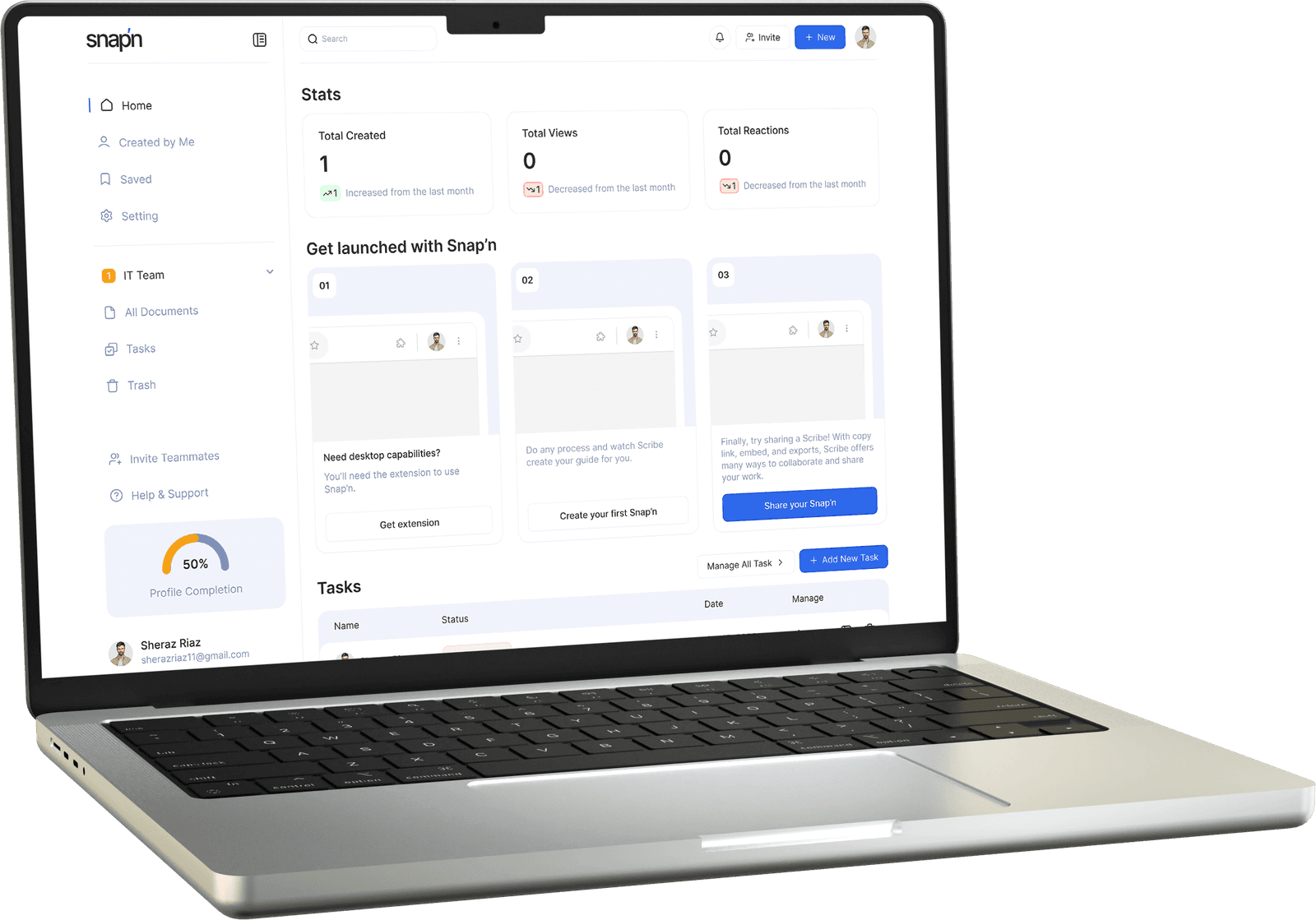
Snapn
Snapn: Accelerating Documentation with AI Workflow Automation
Ability designed and engineered Snapn’s AI-powered documentation platform, helping teams create, manage and scale knowledge with far less manual effort.
- Documentation Time Reduced
- 68%
- Team Productivity Increase
- 2.7x
 Digital Marketing
VVanta
VVanta: AI-Powered Campaign Execution for Digital Marketing
Ability helped VVanta replace fragmented campaign workflows with a structured, AI-powered execution framework spanning Meta, Google Ads, TikTok and programmatic platforms.
- ROAS Improvement
- 50%
- Campaign Setup Efficiency
- 85%
Industries
Industries we serve with AI Development

Startups & SaaS
Software development for startups and SaaS companies that need to validate quickly, ship a dependable product and scale engineering without slowing down.
Learn more
Fintech & Banking
Fintech software development for banks, lenders and payment companies that need secure platforms, modern customer operations and audit-ready delivery.
Learn more
Healthcare
Healthcare software development for providers and health tech companies that need secure, interoperable systems clinicians and patients actually use.
Learn more
Retail & E-commerce
Ecommerce software development for retailers and consumer brands that need fast storefronts, connected inventory and operations that scale with demand.
Learn more
FAQ
AI Development FAQs
What should we look for when choosing an AI development company?
Look for a partner that asks about your workflow and data before recommending a model, and that can show how they measure answer quality. Ask how they handle access control, logging and prompt injection, and whether they can integrate with your existing stack. A good AI partner should also be comfortable telling you when a use case is not a good fit for AI, or when a simpler rules-based approach will do.
What drives the cost of an AI development project?
Cost typically depends on the number and complexity of integrations, the condition of your data, the quality bar the feature must meet, and whether the work needs custom retrieval, fine-tuning or a new user interface. Ongoing model usage is a separate operating cost. We estimate both during discovery and design the architecture so inference spend stays predictable as usage grows.
Will our proprietary data be used to train public models?
Not when the system is designed correctly. We select model providers and deployment options whose terms exclude customer data from training, or use models hosted in your own cloud account where policy requires it. Sensitive fields can be masked before they leave your environment, and every request can be logged so your security team can audit exactly what was sent and when.
Who owns the code, prompts and models you build for us?
Ownership is set out in the statement of work, and engagements are typically structured so that the application code, prompt libraries, evaluation datasets and any fine-tuned model artifacts produced for you belong to you. Third-party models and open-source components remain under their own licenses, which we document so your legal team knows exactly what is proprietary and what is licensed.
Do we need to fine-tune a model, or is RAG enough?
For most business applications, retrieval-augmented generation with strong prompt design meets the quality bar and is easier to keep current, because updating a document updates the answer. Fine-tuning becomes worthwhile when you need a consistent style, a specialized output format or lower cost at high volume. We test both against your evaluation set before recommending one.
How long does it take to get a first AI feature live?
It typically depends on data access, integration depth and how much review the feature needs before release. A narrowly scoped internal assistant can move from discovery to a controlled pilot much faster than a customer-facing feature inside a regulated product. We plan in short iterations so you see working software early and can adjust scope based on real results.
Related services
Often combined with
AI Chatbot Development
Custom AI chatbots and conversational assistants that resolve customer and employee questions using your own knowledge, systems and policies.
Explore serviceMachine Learning Development
Custom machine learning models for prediction, scoring, forecasting and detection, deployed with the MLOps needed to keep them accurate.
Explore serviceAI Automation
Intelligent process automation and AI agents that read documents, make routine decisions and move work between systems with human oversight.
Explore service